

From a 14th‑Century Seaport to a Modern Nation
Prime Minister Lee Hsien‑Loong reminded us on Monday that the year 1819 was the real turning point for Singapore. “That was when the British arrived and turned Singapore into a free port,” he said, explaining how that simple act set the stage for the vibrant, multicultural city we’re proud of today.
Why 1819 Matters
Without the free‑port policy, the island might never have become a melting pot of cultures, or even celebrated independence in 1965. Lee likened the celebration of SG50 to acknowledging that early milestone.
Life’s Story Before 1965
“We’re not just looking back at Stamford Raffles or William Farquhar – though we should – but tracing a longer narrative that stretches back well before 1965,” the PM emphasized. He described a journey from Singapore the island, to Singaporeans the people.
Historic Milestones (in Rough Order)
- 14th Century – The mouth of the Singapore River was a bustling port called Temasek. Sang Nila Utama later founded a kingdom and christened it Singapura.
- 16th/17th Century – Europeans sensed the island’s potential. In 1630, Flemish gem trader Jacques de Coutre pitched a fortress to Spain’s king. If the prince had accepted, Singapore could’ve been a Spanish colony instead of a British one.
- 1819 – Raffles arrived and persuaded the Sultan of Johor to allow the British East India Company to set up a trading post, turning the island into an international free port.
- Early 1900s–1965 – Immigrants from Southeast Asia, China, India, and beyond flooded in. The streets – Malacca Street, Amoy Street, Kadayanallur Street, Bugis Street, Bussorah Street – still echo those diverse roots.
- 1962‑1963 – Silk‑tied to its neighbors, Singapore joined Malaysia. Two years later, it chose independence again.
The Imprint of the British
Lee praised the British legacy for setting a foundation in rule of law, a parliamentary system, and an enduring English language. He admitted, “Let’s not forget the free-port decision—it was the key turning point that eventually put Singapore on the path it’s on today.”
From a Colony to a Cultural Hub
While “Southeast Asian” was part of Singapore’s identity since 1819, the island also carved out a distinct soul, diverging from the society across the Causeway. That subtle difference, in hindsight, helped explain why Singapore separated from Malaysia after just a couple of years of union.
Post‑Separation Prosperity
Despite the emotional drama of separation, Singapore’s journey since 1819 showcased resilience. The mix of trade, cultural hybridity, and strong governance set the stage for an economy that now thrives on the world stage.

Singapore Celebrates 200 Years: A Heartfelt Look at its Evolution
Prime Minister Lee Hsien Loong stood beside a vibrant group of light‑bearers, symbolizing the rich tapestry of communities that have made Singapore home. It was a moment that echoed the city‑state’s journey from a colonial trading post to a proud, independent nation.
From the Dust of War to the Spark of Identity
- During World War II, early settlers in Singapore endured unimaginable hardships, laying silent foundations that would later rise into a bustling metropolis.
- As the world reshaped itself post‑war, a wave of nationalism swept across Asia. The fight for self‑determination grew louder, and Singapore felt the swell of change reverberate through its streets.
- When the Chinese Communist Party emerged victorious, the ripple reached Singapore. The locals began questioning: “Who am I? Should I stay, or should I seek citizenship?” Their answers would become the cornerstone of a new national identity.
Building Community on Solid Ground
Lee highlighted that those who had made Singapore their lifelong home didn’t just sit back. Instead, they organized, united, and pushed against colonial restrictions. In an era when Singapore began as a bustling hub for merchants, it evolved into a place where a genuine sense of belonging took root.
The Birth of a Singaporean Spirit
It was during these transformative years that communities started calling themselves “Singaporeans.” Their collective dream was simple yet profound—they wanted to shape their own destiny, not just be a colony in someone else’s hands.
A Tribute to the Pioneer Generation
Lee praised the Pioneer Generation for their bravery and resilience. They proved that a nation can thrive on its own and that the future belongs to those willing to take ownership of their fate—especially after Singapore’s pivotal separation from Malaysia.
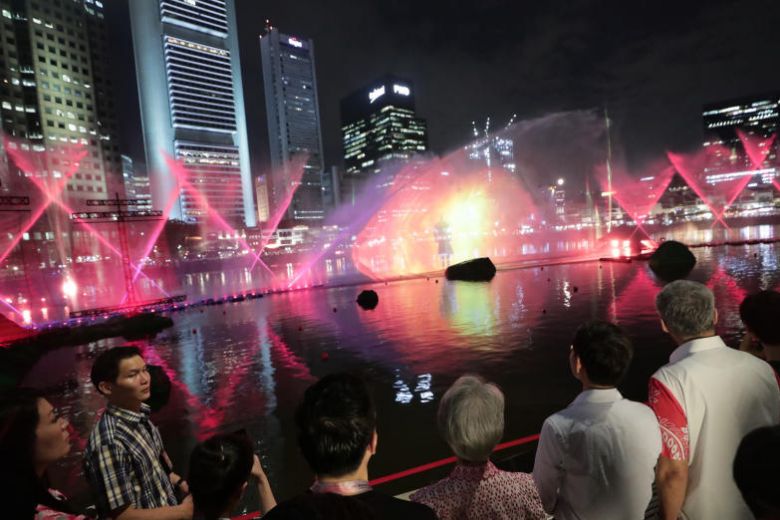
Celebrating 200 Years of Singapore
Scene at the Bridges of Time exhibition:
Prime Minister Lee Hsien Loong, URA CEO Lim Eng Hwee, and Temasek CEO Ho Ching are taking in the stories that span two centuries. The Straits Times sent the photo.
Honouring Those Who Built the Nation
The Prime Minister reminded us that Singapore’s journey was a real-life episode of drama, sweat, and a sprinkling of tears. Those early pioneers tackled swamps, planted cash crops like nutmeg, gambier, and rubber, and got their hands dirty at the quayside—yep, it was a hard job, even for the indentured coolies.
Traders, entrepreneurs, and community builders formed the backbone of the country, creating wealth and giving birth to local customs, clans, welfare organizations, and ethnic associations—think of it as the original social media network.
More Than 200 Groups Come Together
Over two hundred community groups and organisations are putting on honours for the bicentennial. It’s heartening—and a little bit like a big family reunion—how many people are ready to celebrate together.
Looking Ahead: “Building Singapore” Still Goes On
The PM’s words:
“Let us look back at how we got here, and think about how we can leap forward together,” added. He reminded everyone that building Singapore is never finished. Generations will keep adding layers—so that the Singaporeans of tomorrow have an even better story to tell.
- Remember those who cleared the jungle.
- Remember those who struggled at the quayside.
- Remember our merchants who made Singapore a hub.
- Remember the communal bonds that helped us grow.
- And remember—every generation gets a turn in the building process.
For the full speech, check the Straits Times article (just head over to their site if you’re curious). This piece is a tribute to Singapore’s past, a celebration of the present, and a rallying cry for the future—because the “Singapore Story” is only as good as the people writing it.


